2020雅思写作task1范文实例:学习动机
导读:雅思考试写作task1想要达到9分需要完全满足所有的写作任务要求、清晰地呈现充分展开的写作内容;衔接手段运用自如,行文连贯,;熟练地运用分段;能自然地使用并掌握复杂的词汇特征;极少出现轻微错误,且仅属笔误,灵活且准确地运用丰富多样的语法结构;极少出现轻微错误,完全满足所有的写作任务要求,清晰地呈现充分展开的写作内容,有想要在雅思考试中得到写作高分的同学,长沙新东方为你准备了一则协作范文,分享给学生进行日常练习。
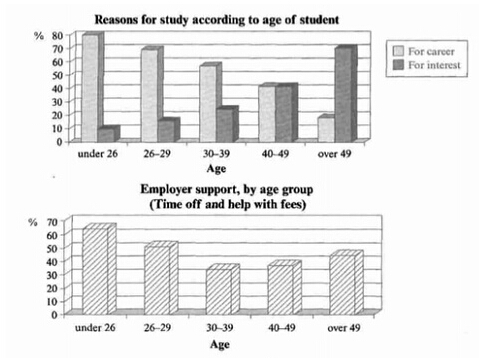
The charts below show the main reasons for study among students of different groups and the amount of support they received from employers.
满分范文:
The bar charts compare students of different ages in terms of why they are studying and whether they are supported by an employer.
It is clear that the proportion of students who study for career purposes is far higher among the younger age groups, while the oldest students are more likely to study for interest. Employer support is more commonly given to younger students.
Around 80% of students aged under 26 study to further their careers, whereas only 10% study purely out of interest. The gap between these two proportions narrows as students get older, and the figures for those in their forties are the same, at about 40%. Students aged over 49 overwhelmingly study for interest (70%) rather than for professional reasons (less than 20%).
Just over 60% of students aged under 26 are supported by their employers. By contrast, the 30-39 age group is the most self-sufficient, with only 30% being given time off and help with fees. The figures rise slightly for students in their forties and for those aged 50 or more.(178 words, band 9)
延伸阅读:
经营许可证编号:
京ICP备05067667号-32 | 京ICP证060601号|
京网文(2016)5762-750号 |
 京公网安备11010802021790号
Copyright 2011-2026 新东方教育科技集团有限公司, All Rights Reserved
新媒体平台资质审核电话:010-60908000-8941

导读:雅思考试写作task1想要达到9分需要完全满足所有的写作任务要求、清晰地呈现充分展开的写作内容;衔接手段运用自如,行文连贯,;熟练地运用分段;能自然地使用并掌握复杂的词汇特征;极少出现轻微错误,且仅属笔误,灵活且准确地运用丰富多样的语法结构;极少出现轻微错误,完全满足所有的写作任务要求,清晰地呈现充分展开的写作内容,有想要在雅思考试中得到写作高分的同学,长沙新东方为你准备了一则协作范文,分享给学生进行日常练习。
The charts below show the main reasons for study among students of different groups and the amount of support they received from employers.
满分范文:
The bar charts compare students of different ages in terms of why they are studying and whether they are supported by an employer.
It is clear that the proportion of students who study for career purposes is far higher among the younger age groups, while the oldest students are more likely to study for interest. Employer support is more commonly given to younger students.
Around 80% of students aged under 26 study to further their careers, whereas only 10% study purely out of interest. The gap between these two proportions narrows as students get older, and the figures for those in their forties are the same, at about 40%. Students aged over 49 overwhelmingly study for interest (70%) rather than for professional reasons (less than 20%).
Just over 60% of students aged under 26 are supported by their employers. By contrast, the 30-39 age group is the most self-sufficient, with only 30% being given time off and help with fees. The figures rise slightly for students in their forties and for those aged 50 or more.(178 words, band 9)
延伸阅读:

 @高三生,高考复习我有这些建议...
 @高三生,高考复习我有这些建议...